
How to mourn for a lost one? How to hold on to what is so precious? Louisa Fairclough has possibly found a unique way through her on-going interaction with her deceased sister’s work. For some time now this has led to a most intricate and intriguing body of work that is in a way somewhat uncomfortable to be confronted with but also extremely poetic and delicate. Starting points are often sketches and drawings that her sister made. ‘I wish I could be a stone’ at Danielle Arnaud takes its title from a sketch by her sister with this text. As Fairclough describes it herself The sketch hovers between a drawing, a poem and a visual score. Clustered about the page are the pencil outlines of pebbles. There is also very faintly the sense of a landscape: a horizon and the mast of a boat. It appears as though my sister was sitting on a shingle beach picking up the pebbles around her and drawing around each before writing the phrase ‘I wish I could be a stone’ within each pebble outline. I imagine how when she walked away, she would have left her own sitting body’s stone-shaped impression on the beach. 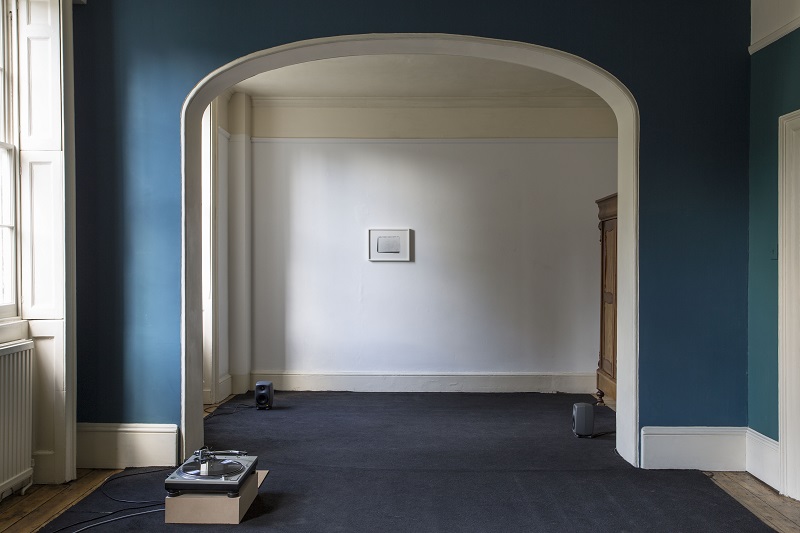
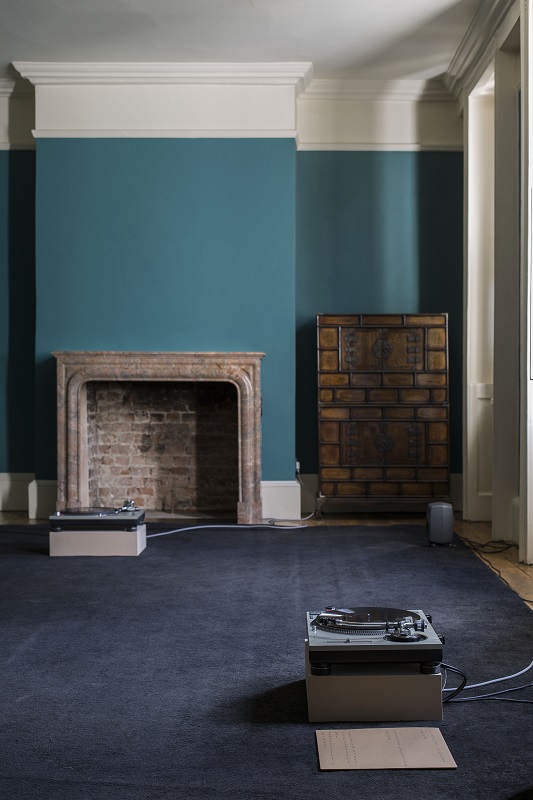 Louisa Fairclough, I wish I could be a stone, 2014 Thus a drawing becomes a soundscape, a sculpture, a performance. It is this almost magical ability to transform one medium into a myriad of others that defines Fairclough’s work. At Arnaud this becomes an intricate combination of in fact two installations that sit on the two floors of the gallery. ‘I wish I could be a stone’ on the first floor includes her sisters drawing but is actually a duet for two turntables in collaboration with composer Richard Glover. Each turntable plays a record that holds the sound of a chorister singing the phrase on the sketch while sitting on a shingle beach, picking up and dropping a pebble while singing. Their high-pitched voices could in a way be interpreted as the sisters echoing each other, in an ongoing giving and returning game. Absolute Pitch II is situated on the ground floor and consists of several projectors on high plinths, that by now form one could say Fairclough’s trademark. Again it’s a case of not being what it seems as Fairclough not necessarily uses her projectors to project film. They do project an image as their film loops weave a pattern throughout the room and cast their shadows, but they are used in the first place to emanate the sound of five choristers singing lines from a monoprint by Fairclough’s sister. Meanwhile the room changes colors through the projectors without lenses according to the ones the choristers associated with the quality of sound they produced. [Documentation on the first version commissioned by and shown at the Whitstable Biennale earlier this year can be found here.]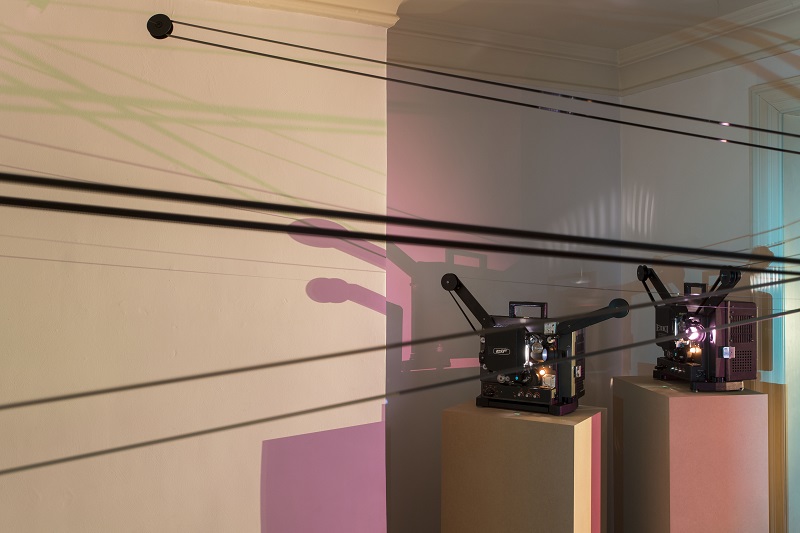
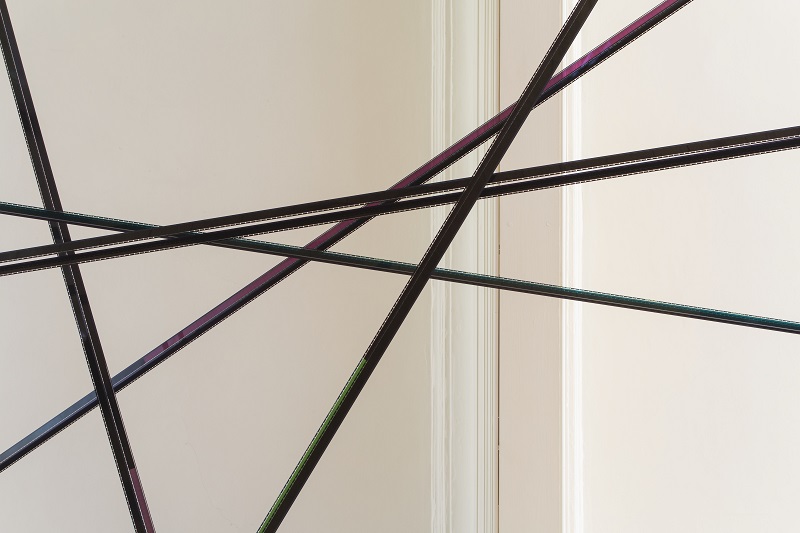 Louisa Fairclough, Absolute Pitch II, 2014 During the opening night of the exhibition a third piece was performed in the stairwell that connects both floors of the gallery. While the other two installations resonated with each other, this was the connecting piece adding a third layer. Two choristers alternatingly sang the words ‘Awkward’ and ‘Relaxed’, again interpreting a sketchbook drawing as a score, while imagining a pendulum swinging through the space. As Fairclough explains: “The chorister lower down the stairwell was singing ‘Awkward’ on a higher pitch, whilst the chorister at the top of the stairwell was singing ‘Relaxed’ on a lower pitch. The third pitch in the harmony was the B above middle C (from Absolute Pitch II), this resonated through the gallery. I consider the works to be modular all coming together chorally.” (From email conversation with the artist). It was quite moving to witness the concentration of the chorister that I could see from my position, his deeply inward looking, his imagining that was suddenly put to a hold after ten minutes when the timekeeper called ‘End’ that shook him clearly out of this concentrated state. Typical for Fairclough’s knack for precision that this connecting element of ‘Relaxed Awkward’ is also reflected in the way she has documented the show on her website. Similarly it is exactly notions like precision, inward looking, concentration and ‘absolute pitch’ that define her multi-layered work. The setting in a gallery that is also a house and home resonates extremely well with it which is obviously not a coincidence but something Fairclough has clearly put into the mix. So mourning, yes, but possibly even more than that celebrating and re-inventing, with each added work, echoing indeed like the choristers, into something that is elevated to a higher state. I wish I could be a stone – Louisa Fairclough at Danielle Arnaud contemporary art until 26 October 2014 More info at www.daniellearnaud.com
 edith doove
Leave a comment