
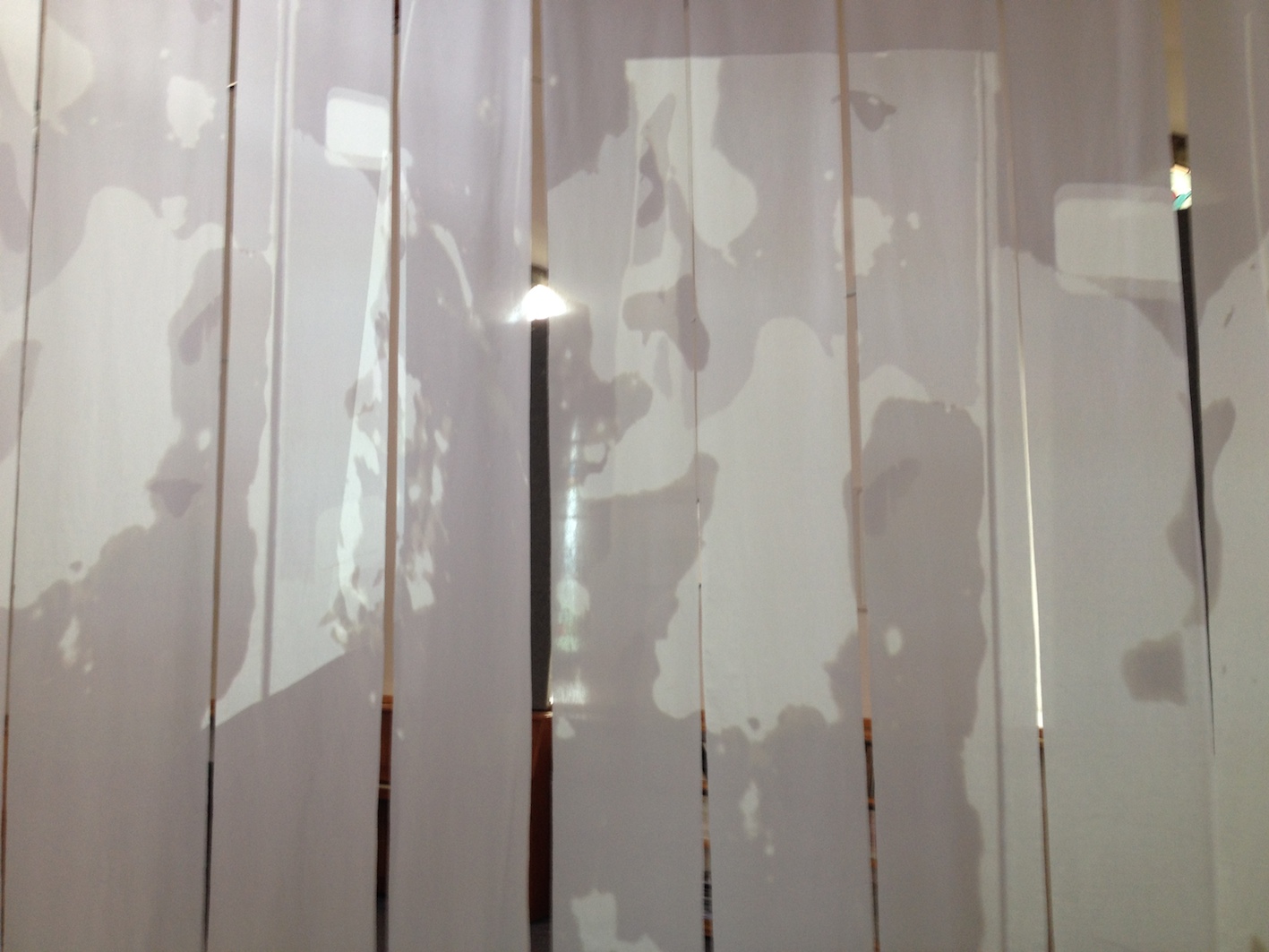
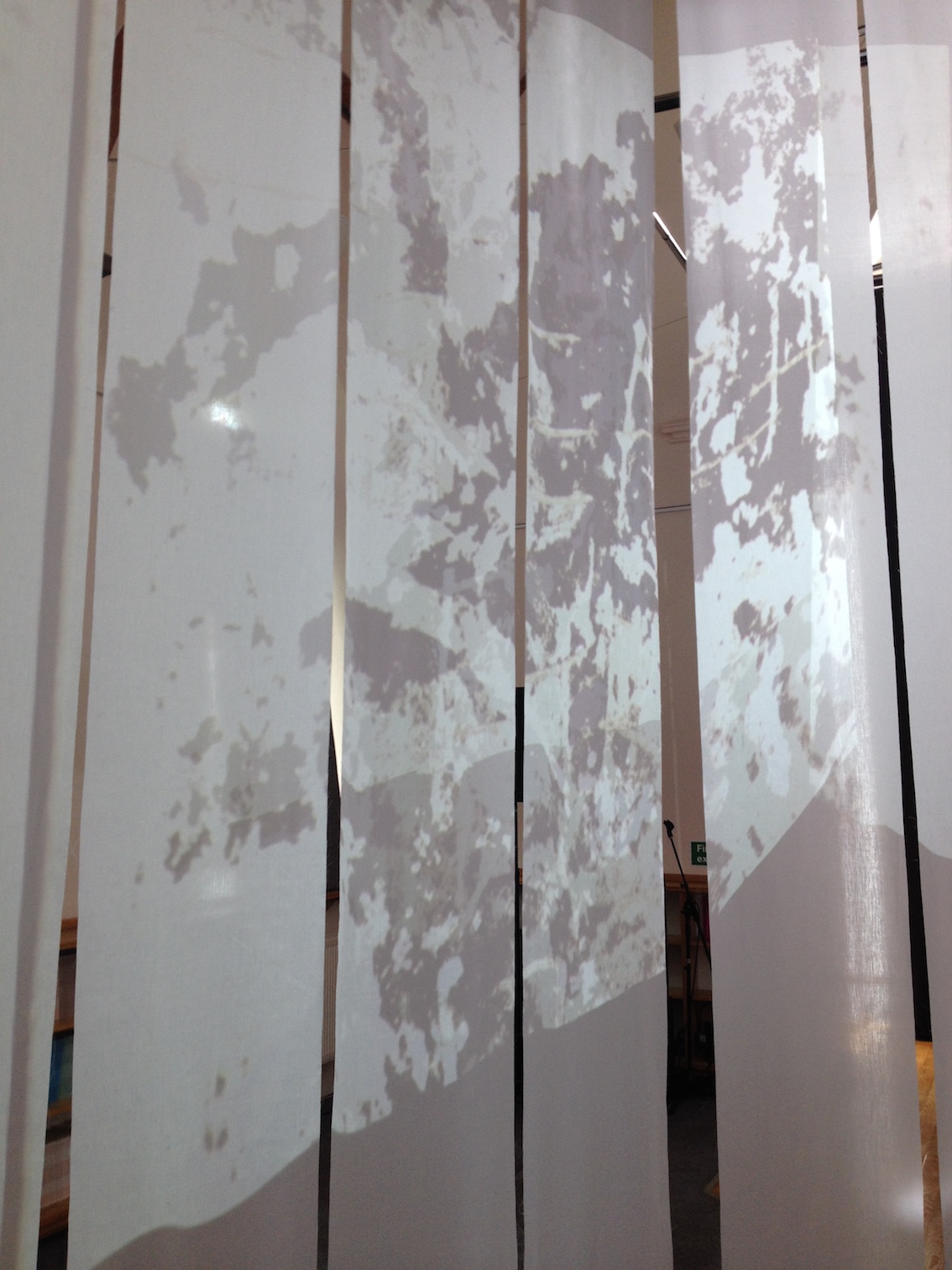
 Kayla Parker and Stuart Moore, Reach, 2014
One of the first things that leaves a strong impression when I enter Calstock Art Centre to see Kayla Parker’s and Stuart Moore’s installation Reach is the sound of a hover fly. It reminds me that the river is so many things, not only the flow of the water through a landscape but also (obviously in a way) the flora and fauna in and around it. The hover fly entered the sound track of Reach when Parker and Moore retracted the strips of 16 mm film they had buried into the outer reaches of the river Tamar and were recording this process. Suddenly there was that unexpected sound relatively high up in the air and it now forms a kind of counter point in the installation together with various underwater sounds. The process of how the images for this installation were made is an important part of Reach as it is actually the river that has made the film. Its bacteria and microbes, the tug of ebb and flow, have left their marks on the film, stained it and crinkled it, the result of which was then transferred into digital images. In the installation these are shown on long vertical strips of fabric, hung in a circle that you can freely enter and exit, referring to the strips of film that produced the images, but also the tidal movements of the river. As mentioned before (see post ‘Writing the River’, 12 September 2014) Parker’s and Moore’s working method is a kind of close reading of their subject and an immediate interaction with it. Their experimental way of working with film was also demonstrated in a workshop around amongst others the use of found footage resulting in a short movie made by the participants.
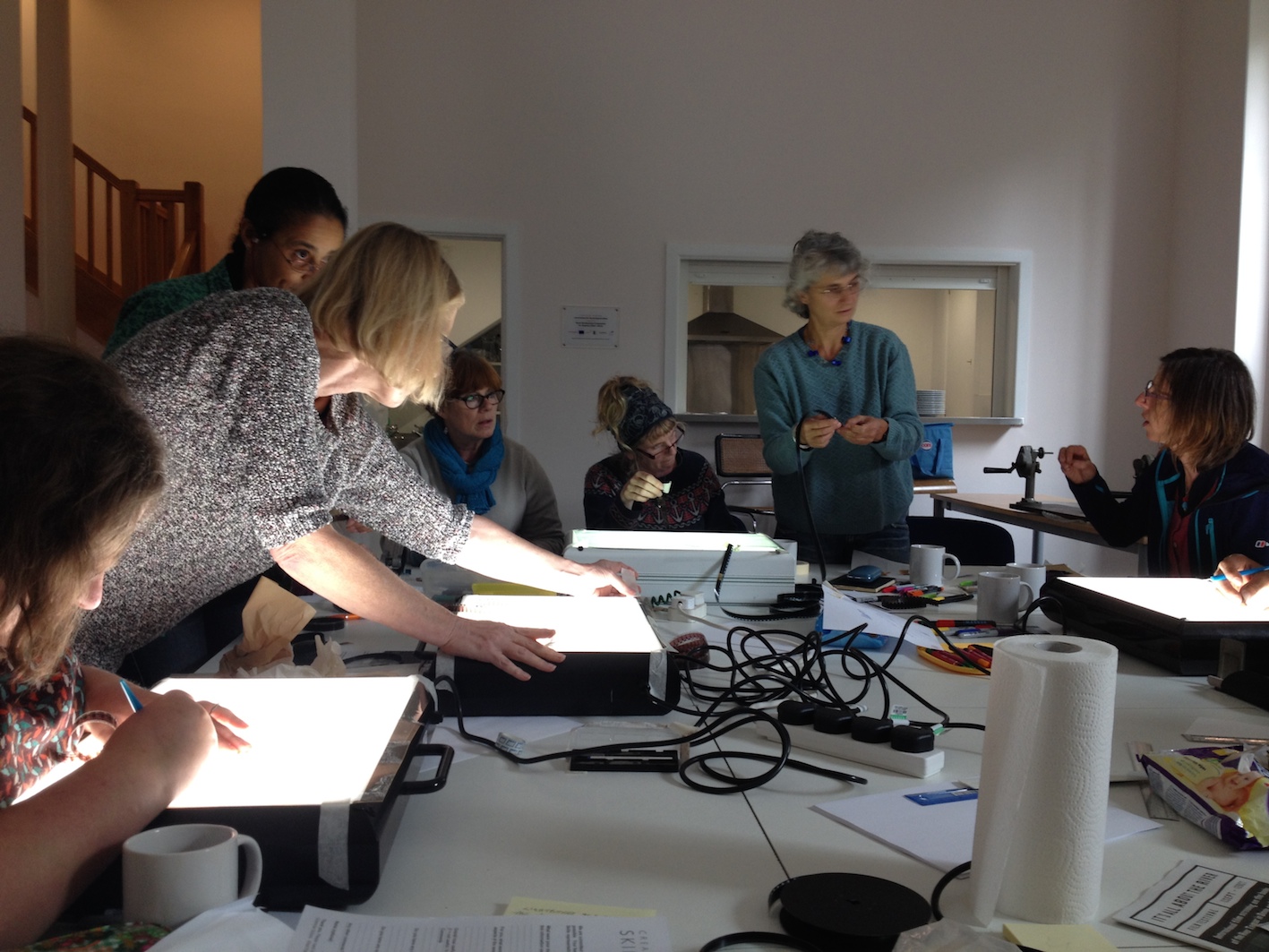 Kayla Parker and Stuart Moore, workshop
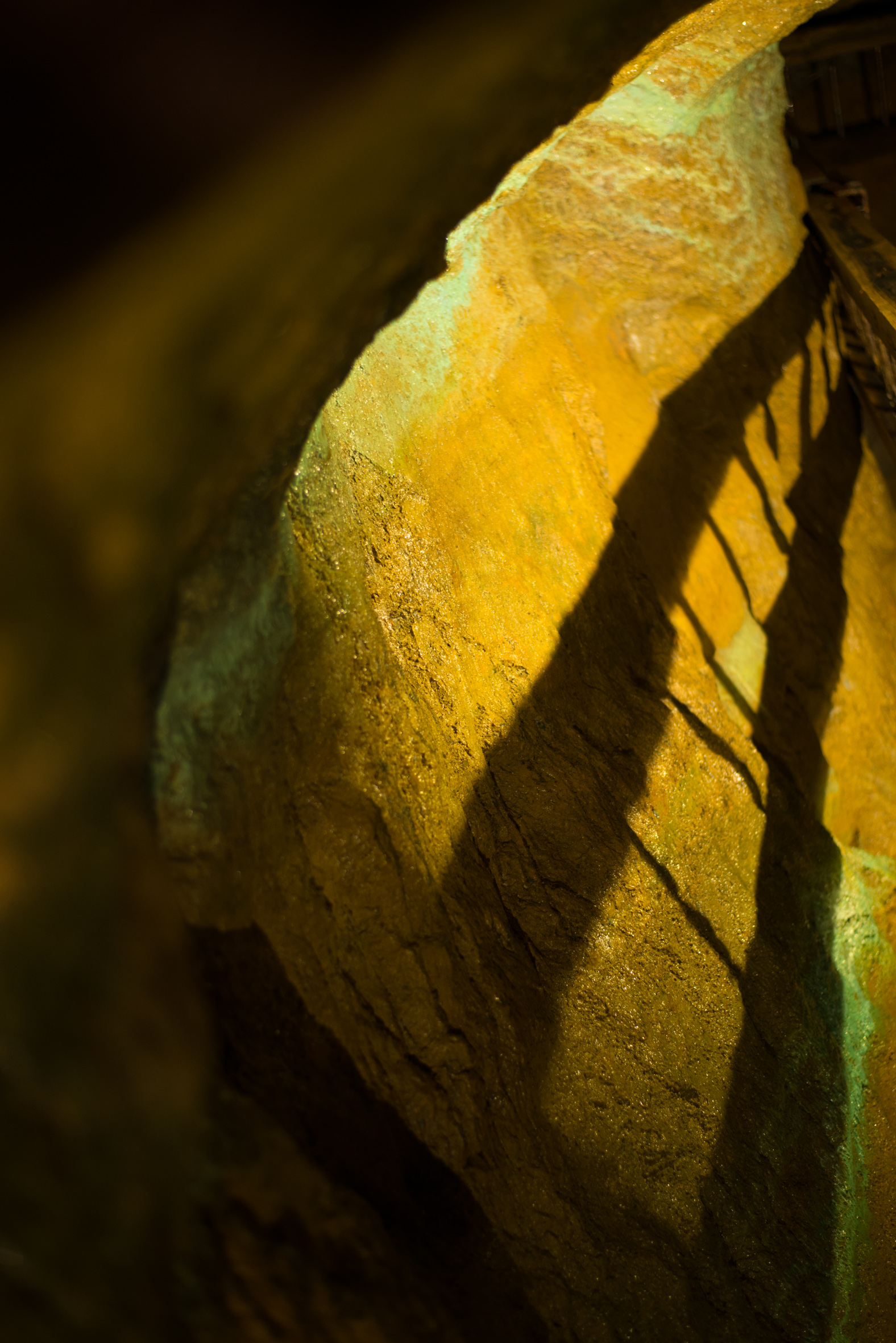 Uriel Orlow, The Mussels Perspective 2014
Although completely different in outlook there are quite some comparisons to make with Uriel Orlow’s installation ‘The Mussels’ Perspective’ that was on show in Calstock Village Hall. The looped film is a combination of 16mm and digital images that reveal the fact that today’s mussels in the Tamar estuary still suffer the effects of the mining of about a hundred years ago. Starting with an image of mussels in a laboratory of Plymouth University, views of the outer reaches of the river and former mining grounds are combined with three short digitalised interstices. The first shows a slowly turning mussel while a voice (Orlow himself) tells the story of how Houdini performed one of his famous underwater escape acts at Stonehouse in Plymouth (http://plymouthlocalhistory.blogspot.co.uk/2009/03/houdini-in-plymouth.html). The second image shows a slow turning piece of copper alluding to the mining industry and the amount of copper and arsenic particles still flowing out into the river and sea as a result of this. The third image is that of a slow turning piece of arsenic and mentions the use of vibrant green arsenic by William Morris in his wallpaper. The damp houses at the end of the 19th century would however cause the evaporation of toxic acids and serious illnesses of their occupants. Orlow shows most of the rest of his film in reverse with the eerie effect of water flowing upstream. In a conversation with Lucy Reynolds about his work Orlow alluded to how this is a way to show the effects of the past on the presence, something he generally is interested in and that also comes to show in most of his other work. He likes to discuss this effect in terms of ‘spatial history’ where local, often forgotten, histories connect to larger overarching histories.
Just like Parker and Moore, Orlow shows an aspect of the river that we cannot immediately see. A landscape that is generally seen as part of world heritage and the epitaph of beautiful is in fact poisoned and makes mussels unfit for consumption. Orlow’s soundtrack is just as Parker’s and Moore’s a mixing and moving of sounds into each other, the sounds of the mines that he visited and that of the flowing water, resulting in an hypnotising drum.
It is a shame that Kayla Parker and Stuart Moore were not included in this conversation, as it would have pulled both installations beautiful together.
http://www.itsallabouttheriver.org.uk
 edith doove
Leave a comment